Henderson Nevada sits at an elevation of about 2,000 feet above sea level, with the Las Vegas Valley's arid alluvial geology dominating the subsurface. The ground here is a mix of silty sands, gravels, and caliche layers that can vary sharply over short distances. When we plan an electrical resistivity survey or vertical electrical sounding (VES) in Henderson Nevada, we are essentially mapping these hidden contrasts. The method sends a controlled current into the ground and measures how different soil and rock layers resist that flow. It works especially well in the dry desert environment where shallow bedrock and cemented layers are common. We use this data to identify depth to groundwater, locate paleochannels, and detect zones of high salinity before any excavation begins. Combining VES with a georradar survey gives us a clearer picture of the shallow subsurface.
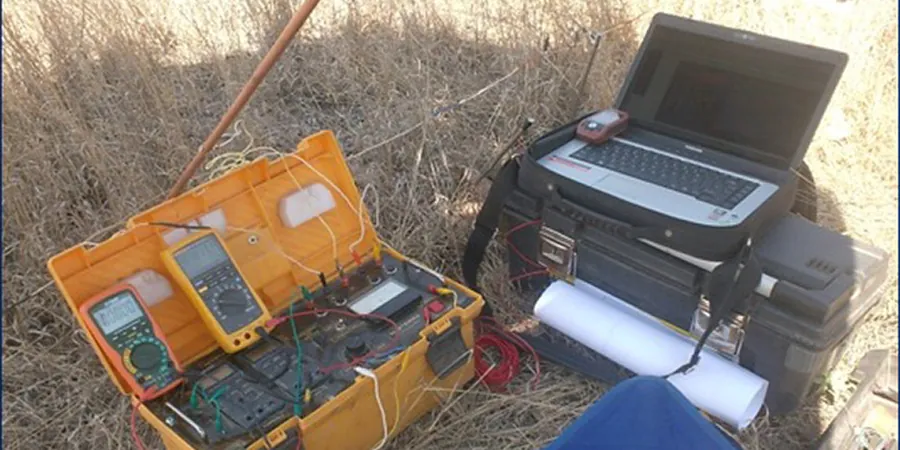
In the dry alluvium of Henderson Nevada, electrical resistivity profiles reveal buried stream channels and caliche layers that could compromise foundation performance.
Scope of work in Henderson Nevada
Critical ground factors in Henderson Nevada
We see it often in Henderson Nevada: a developer assumes the soil is uniform because the surface looks flat and dry. Then during excavation they hit a buried channel with loose sand and water. That stops the job, costs time, and forces redesign. Electrical resistivity surveys catch these hidden features before you break ground. If you skip this step, you risk foundation settlement in the loose zone or unexpected groundwater inflow. The cost of a resistivity survey is small compared to the delay and repair of a failed slab. We pair the survey with cimentaciones y rellenos analysis to translate the resistivity layers into practical bearing recommendations.
Our services
We offer two focused services built on electrical resistivity in Henderson Nevada.
2D Electrical Resistivity Imaging (ERT)
Multi-electrode array with automated switching to produce continuous 2D cross-sections. Ideal for mapping layer boundaries, groundwater depth, and anomalous zones on large lots or linear alignments.
Vertical Electrical Sounding (VES)
Central point sounding with increasing electrode spacing for depth profiling. Best for single-borehole verification or small building pads where lateral variation is minimal.
Frequently asked questions
How does electrical resistivity compare to drilling in Henderson Nevada?
Resistivity surveys are non-invasive and cover a larger area than a single borehole. In the dry alluvium of Henderson Nevada, they can detect caliche layers and paleochannels that a borehole might miss. We still recommend a few confirmation boreholes for critical structures, but resistivity reduces the number needed.
What is the typical cost range for a VES survey in Henderson?
A single vertical electrical sounding (VES) in Henderson Nevada typically ranges between US$680 and US$1,050, depending on the depth required and access conditions. A full 2D profile with multiple lines costs more but gives broader coverage.
How deep can a VES survey reach in Nevada desert soils?
With a standard 50-meter electrode spread we can reach about 30 meters in the dry alluvium. If we extend the spread to 100 meters, depths up to 60 meters are achievable, though resolution decreases at lower depths.
Do I need an electrical resistivity survey for a residential slab?
For a single-family home on a lot that has not been previously built on, it may not be required by code. However, if the lot is near an old wash channel or in an area with known caliche, a resistivity survey can prevent settlement issues. We often recommend it for hillside lots or when the builder has limited geotechnical data.