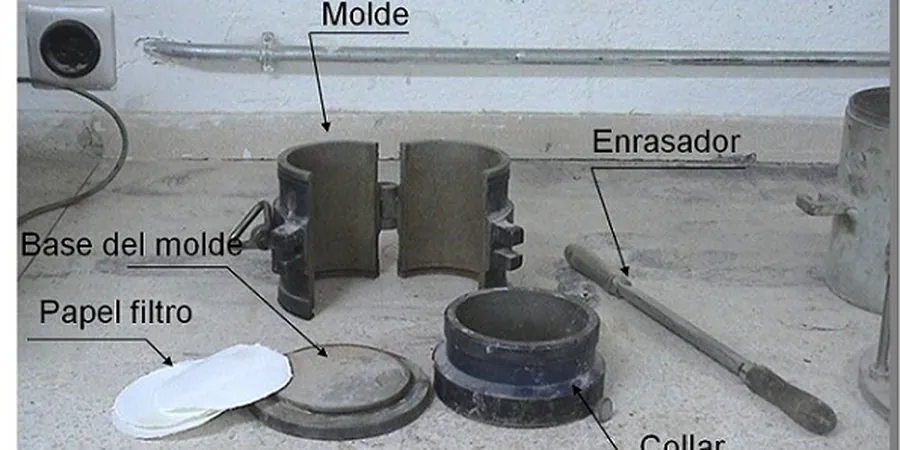
On a typical morning in Henderson Nevada, our technicians roll out with a manual Proctor hammer, a set of 4-inch and 6-inch molds, and a calibrated scale that has been cross-checked against a reference weight the day before. The first step at any site is to retrieve a representative bulk sample from the borrow area or the footing excavation. Back at the lab, we air-dry the material, break up clods, and pass it through a No. 4 sieve before splitting it into five or six subsamples. Each subsample receives a different moisture content, compacted in three or five equal layers depending on whether we are running the standard (ASTM D698) or modified (ASTM D1557) procedure. For projects that also require shear strength characterization, we often coordinate the Proctor test with a ensayo triaxial to evaluate how moisture-density relationships affect undrained strength.
A single percentage point shift in optimum moisture can change dry density by 3 pcf, altering the entire compaction acceptance criteria for a project.
Scope of work in Henderson Nevada
Critical ground factors in Henderson Nevada
Henderson Nevada sits within the Basin and Range province, where alluvial fan deposits and playa sediments dominate the shallow subsurface. The soils are often well-graded sands and gravels with intermittent clay lenses, but the moisture regime in the Mojave Desert is extremely low. Natural in-situ moisture rarely exceeds 5 percent. If a contractor applies the Proctor curve from a lab sample without adjusting for the arid field conditions, they can overestimate the water needed to reach optimum. The result is a fill that appears dry but actually lacks the lubrication for particle rearrangement. Under compaction, that fill will settle unevenly under load, especially during the rare heavy rain events that saturate the upper few feet. We have seen differential settlements of up to 2 inches on slabs where the Proctor curve was not validated with field density tests during placement.
Our services
Beyond the basic Proctor curve, we offer complementary compaction-control services tailored to projects in Henderson Nevada.
Field Density Testing (Sand Cone & Nuclear Gauge)
In-situ density verification using the sand cone method (ASTM D1556) or nuclear gauge (ASTM D6938) to compare field compaction against the Proctor maximum dry density. We provide immediate pass/fail results for each lift.
Moisture-Density Curve for Imported Borrow
Custom Proctor curves on borrow materials from off-site sources before they arrive at the project. This avoids delays when a truckload of material has a different optimum than the original design curve.
Modified Proctor for Heavy Load Areas
High-energy compaction curves for structural fills under crane pads, retaining walls, or warehouse racking zones. The modified energy level simulates heavier rollers and prevents long-term settlement under sustained loads.
Frequently asked questions
What is the difference between standard and modified Proctor tests?
The standard Proctor test (ASTM D698) uses a 5.5-pound hammer dropped 12 inches, applying 12,400 ft-lbf per cubic foot of soil. The modified test (ASTM D1557) uses a 10-pound hammer dropped 18 inches, applying 56,000 ft-lbf per cubic foot. The modified test simulates heavier compaction equipment and typically yields a higher maximum dry density with a lower optimum moisture content.
How much does a Proctor test cost in Henderson Nevada?
A single Proctor curve (standard or modified) for a soil sample typically ranges from US$110 to US$190 in the Henderson area. The price includes sample preparation, the five-point curve, and the moisture-density report. Multi-sample discounts or projects requiring rapid turnaround may adjust the total.
Why do I need a Proctor test if I already have a geotechnical report?
A geotechnical report often provides a representative Proctor curve for the general soil type on site, but every borrow source and every lift of fill can vary slightly in gradation or plasticity. A site-specific Proctor test on the actual material being placed gives the contractor a precise target for moisture and density, reducing the risk of under-compaction or over-wetting.
Can I use the same Proctor curve for all fill layers on a large site?
Not reliably. Different excavation zones in Henderson Nevada often expose distinct alluvial layers: one area may yield a silty sand while another yields a gravelly clay. Each distinct soil type requires its own Proctor curve. Using a single curve across variable soils can lead to acceptance of under-compacted lifts or rejection of properly compacted ones.