The 2021 IBC and ASCE 7-16 both mandate that foundations on fill must be designed based on a site-specific geotechnical investigation that addresses the fill's density, uniformity, and long-term settlement behavior. In Henderson Nevada, where large tracts of land have been graded and filled over the past decades to accommodate residential and commercial growth, this analysis is especially critical. The city's position within Clark County places it in a region where alluvial fan deposits and colluvial soils were historically reworked during land development, so verifying that those fills meet compaction specifications is non-negotiable. We evaluate fill thickness, compaction records, and perform in-situ density testing alongside a classificacion de suelos to classify the material and a ensayo proctor to confirm whether the achieved dry density meets the project's design criteria.
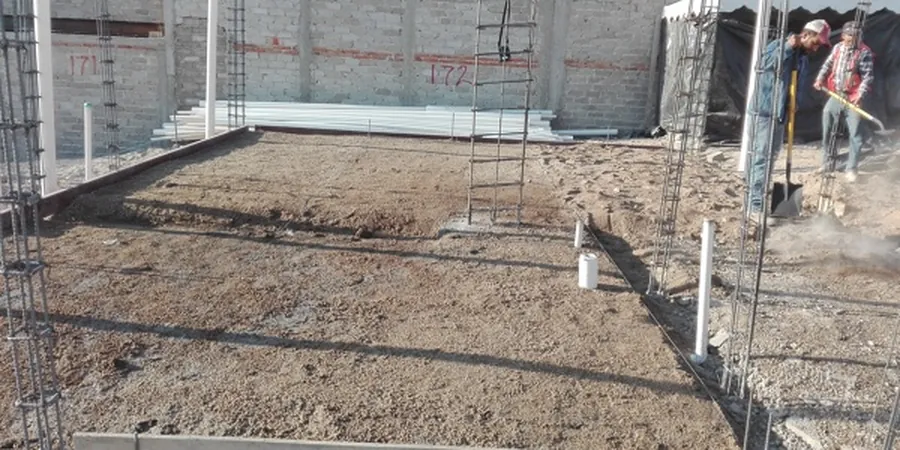
For fills deeper than 15 feet, plate load testing at the foundation subgrade provides direct measurement of the modulus of subgrade reaction.
Scope of work in Henderson Nevada
Demonstration video
Critical ground factors in Henderson Nevada
In Henderson Nevada, we frequently see fills that were placed during the 1990s boom without adequate compaction records, especially on the eastern side near the McCullough Range. These uncontrolled fills can exhibit sudden collapse upon wetting because the silty matrix loses apparent cohesion when saturated. During a 2022 monsoon event, a parking lot slab on fill settled 4 inches overnight due to this mechanism. The risk is compounded by the region's deep water table — typically below 100 feet — so capillary rise never helps stabilize the vadose zone. We always recommend a collapse potential test (ASTM D5333) on any fill that will support a structure, combined with a site-specific infiltration analysis to predict post-construction moisture changes.
Our services
Our full scope of foundations on fill analysis in Henderson Nevada includes the following integrated services:
Field Density & Compaction Verification
Nuclear gauge and sand cone tests at 2-ft vertical intervals within test pits, correlated with laboratory Proctor curves to confirm that fill meets the specified relative compaction.
Settlement & Collapse Evaluation
One-dimensional consolidation (ASTM D2435) and double-oedometer collapse tests on undisturbed fill samples to predict both immediate and long-term deformations under design loads.
Bearing Capacity & Plate Load Testing
In-situ plate load tests (ASTM D1196) at the proposed foundation subgrade to determine the modulus of subgrade reaction and verify the allowable bearing pressure for spread footings on fill.
Frequently asked questions
How deep can foundations be placed on fill in Henderson Nevada?
There is no single depth limit — it depends on the fill's thickness, compaction quality, and the building's load. For light commercial structures, we typically recommend footing depths of 2 to 4 feet below grade after verifying that the fill meets 95% of standard Proctor. Deeper fills (over 15 ft) may require deep foundations or ground improvement.
What is the difference between a compacted fill and an uncontrolled fill?
A compacted fill is placed in controlled lifts of 8 to 12 inches, moisture-conditioned, and compacted to a target density (typically 95% Standard Proctor). An uncontrolled fill, common in older developments in Henderson Nevada, was dumped and spread without compaction testing. Uncontrolled fills pose a high risk of differential settlement and collapse upon wetting.
What tests are used to verify fill quality for foundations?
Field tests include nuclear density gauge (ASTM D6938), sand cone (ASTM D1556), and plate load tests (ASTM D1196). Laboratory tests include standard Proctor (ASTM D698), Atterberg limits (ASTM D4318), and collapse potential (ASTM D5333). We also perform sieve analysis to check for oversized particles that could create settlement voids.
Can you build directly on fill without ground improvement?
Yes, but only if the fill is well-compacted, uniform, and less than about 10 feet thick. For fills exceeding 10 feet or those with unknown compaction history, ground improvement — such as dynamic compaction, stone columns, or deep soil mixing — is often required. In Henderson Nevada, we frequently recommend a site-specific fill investigation before deciding.