The alluvial soils of the Las Vegas Valley, which underlie much of Henderson, present a well-known challenge: high compressibility and low permeability. When we design a prefabricated vertical drain (PVD) system here, the primary goal is to drastically shorten the drainage path, turning what could be years of settlement into just a few months. Our approach starts with site-specific consolidation testing to define the coefficient of consolidation (Cv) and the target degree of consolidation, typically set above 90% for structural fill. Before finalizing the PVD layout, we always recommend a complementary resistivity survey to map subsurface variability and identify any shallow bedrock or paleochannels that could disrupt drainage. This combination of lab data and geophysics is what makes a PVD design truly site-adapted.
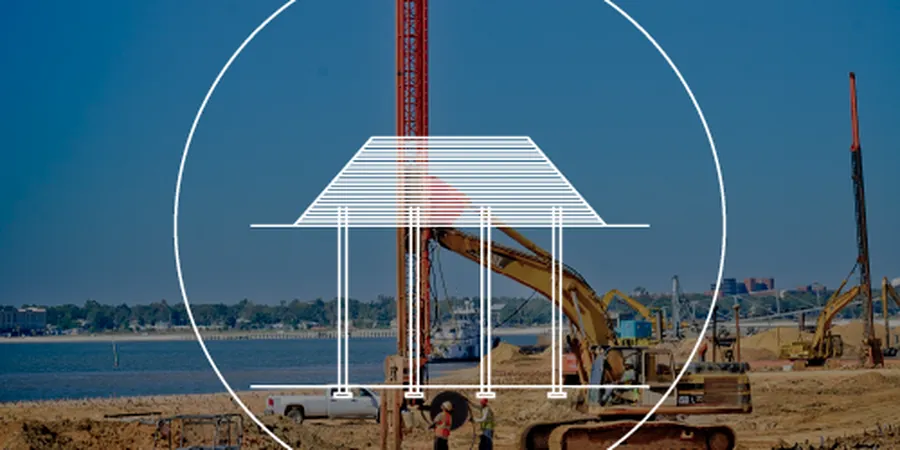
In Henderson's alluvial soils, PVD design reduces settlement time from years to months by shortening the drainage path from 10 meters to 1.5 meters.
Scope of work in Henderson Nevada
Critical ground factors in Henderson Nevada
A mistake we see often in Henderson is assuming that a uniform PVD layout works for the entire site. The alluvial stratigraphy here changes rapidly — one area might be clean sand, the next a fat clay (CH). If you don't adjust the drain spacing or type accordingly, you either over-design (wasting money) or under-consolidate (risking differential settlement). Even worse, some contractors skip the consolidation test entirely and guess the Cv value. That guess can lead to a design that either takes too long or fails to meet the required post-construction settlement, which in a residential subdivision or commercial slab can mean cracked foundations and costly repairs.
Our services
We offer a complete PVD design service package tailored to Henderson's soil conditions, from initial characterization through final QA/QC.
Consolidation Testing & Soil Characterization
Laboratory oedometer tests (ASTM D2435) to determine Cv, Cr, and preconsolidation pressure. Includes index property tests for soil classification.
PVD Layout & Surcharge Design
Detailed spacing, pattern, and drain length calculations. Includes surcharge height optimization and staged loading recommendations.
Field Monitoring & Performance Verification
Installation of piezometers and settlement plates. Real-time pore pressure monitoring during surcharge to confirm consolidation progress.
Frequently asked questions
How do PVDs work in Henderson's silty soils?
In silty soils, the horizontal permeability (kh) is often higher than vertical (kv), so PVDs accelerate drainage by providing a vertical path for water that would otherwise migrate slowly through the silt. The drain acts as a wick, collecting pore water from the surrounding soil and conveying it to a sand blanket or drainage layer at the top. The key is to ensure the filter jacket is designed with a permeability high enough to prevent clogging by fines.
What is the typical cost range for a PVD design in Henderson?
The cost for a complete PVD design package, including consolidation testing, layout, and monitoring plan, typically ranges between US$950 and US$2,380. The final price depends on the number of test locations, site complexity, and the depth of drains required.
Can PVDs be used in areas with shallow groundwater?
Yes, PVDs are particularly effective in saturated soils because the hydraulic gradient is higher. In Henderson, areas near the Las Vegas Wash have groundwater within 3-5 meters of the surface. The drains must be installed with a sand blanket that extends above the water table to allow free drainage by gravity, and the surcharge fill must be designed to avoid heave during placement.
What is the difference between PVD and vertical sand drains?
PVDs (also called wick drains) are prefabricated plastic cores wrapped in a geotextile filter. They are much faster to install than sand drains, cause less soil disturbance, and can be placed in tighter spacings. Sand drains require a borehole and a clean sand column, which is more expensive and slower. For most projects in Henderson, PVDs are the preferred solution because of their cost-effectiveness and reliability.