The soil profile near Green Valley differs sharply from the alluvial fans along the McCullough foothills. In Henderson Nevada, soft soil tunnels must contend with loose sands, silty clays, and groundwater depths that vary by more than 20 feet across the city. A proper geotechnical analysis for soft soil tunnels distinguishes between a stable excavation and a collapse. Before specifying support, we evaluate the ground with a resistivity survey to map stratigraphy, then confirm with SPT borings. Hand augers cannot reach the 50-foot depths common in Henderson Nevada; truck-mounted rigs are standard. The analysis determines stand-up time, water inflow rates, and the need for pre-support.
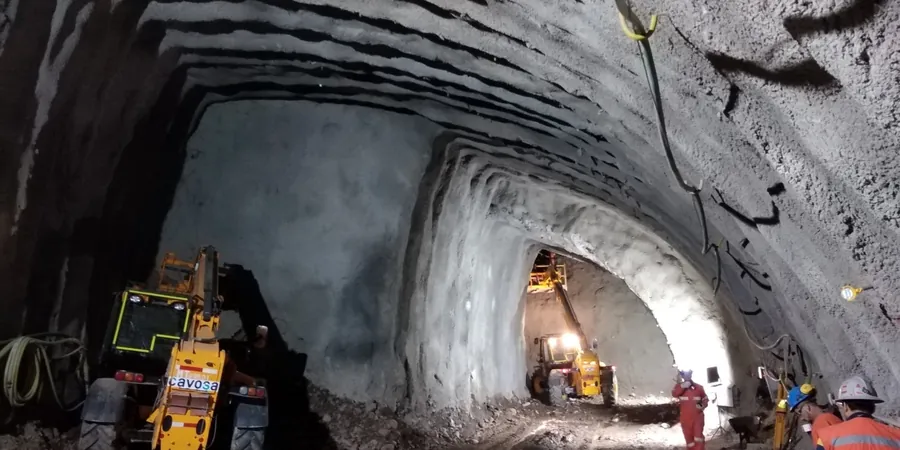
A 15-foot tunnel in loose alluvium can lose 12 inches of crown settlement within hours without proper pre-support and soil characterization.
Scope of work in Henderson Nevada
- SPT (ASTM D1586) every 5 feet to log blow counts and soil type
- Undisturbed sampling for triaxial and consolidation tests
- Collapse potential evaluation on dry sands
Critical ground factors in Henderson Nevada
Henderson Nevada recorded a population of 337,000 in the 2024 census, and its urban footprint continues expanding southeast into the Sloan Hills. Every new tunnel — whether for utilities, stormwater, or pedestrian underpasses — crosses alluvial sediments deposited by flash floods. These soils are loose, poorly graded, and prone to raveling. A geotechnical analysis for soft soil tunnels must flag caving zones and recommend ground improvement. Losing the face during excavation in Henderson Nevada can trigger surface subsidence affecting adjacent pavement and utilities. The analysis quantifies that risk and prescribes countermeasures like spiling or forepoling.
Our services
Our laboratory and field services cover the full spectrum of tunnel geotechnics. Each service is tailored to Henderson Nevada conditions and performed under ISO 17025 accreditation.
Borehole Drilling and SPT
Mud-rotary or hollow-stem auger drilling to depths of 80 feet with SPT sampling every 5 feet. Logging per ASTM D2488.
Seismic Site Classification (Vs30)
MASW or downhole shear-wave velocity profiling to determine ASCE 7 site class for tunnel dynamic analysis.
Laboratory Strength Testing
Consolidated-drained triaxial (ASTM D7181) and direct shear (ASTM D3080) on representative samples.
Groundwater Monitoring
Installation of vibrating-wire piezometers and periodic water level logging over at least one wet-dry cycle.
Frequently asked questions
What is the difference between SPT and CPT for soft soil tunnels in Henderson Nevada?
SPT provides disturbed samples and blow counts for soil classification. CPT gives continuous cone resistance and pore pressure readings without retrieving soil. In Henderson Nevada, both are used: SPT for gravelly layers and CPT for finer sands where continuous profiling matters.
How deep does the geotechnical analysis need to go for a pedestrian tunnel?
For a typical pedestrian tunnel with invert at 15-20 feet, borings should extend at least 10 feet below the planned invert. In Henderson Nevada, we recommend 40-foot borings to capture the full soil profile and groundwater conditions.
What is the typical cost range for a soft soil tunnel geotechnical analysis in Henderson Nevada?
The cost typically ranges from US$4,240 to US$16,280 depending on the number of borings, laboratory tests, and groundwater monitoring required. A standard analysis with four boreholes and basic lab falls near the lower end.
Does the analysis include recommendations for tunnel support?
Yes. The report provides recommended lining type, thickness, and pre-support measures based on ground classification. For soft soils typical of Henderson Nevada, steel ribs with lagging or shotcrete are common.