With an average annual rainfall under 5 inches and expansive clay deposits from the Las Vegas Formation, Henderson Nevada presents a unique challenge for slope stability. The Black Mountain fault zone adds seismic loading concerns that can trigger movement in cut slopes along the Anthem and Lake Las Vegas corridors. Our monthly geotechnical slope monitoring program tracks millimeter-scale displacements using inclinometer casings and surface prisms, catching progressive failures before they reach critical levels. These readings are cross-referenced with local rain gauge data and the nearest seismograph station to isolate whether movement is moisture-driven or tectonic. For deeper analysis of sub-surface conditions, we combine this data with a resistivity survey to map bedrock depth and groundwater anomalies beneath the monitored slope.
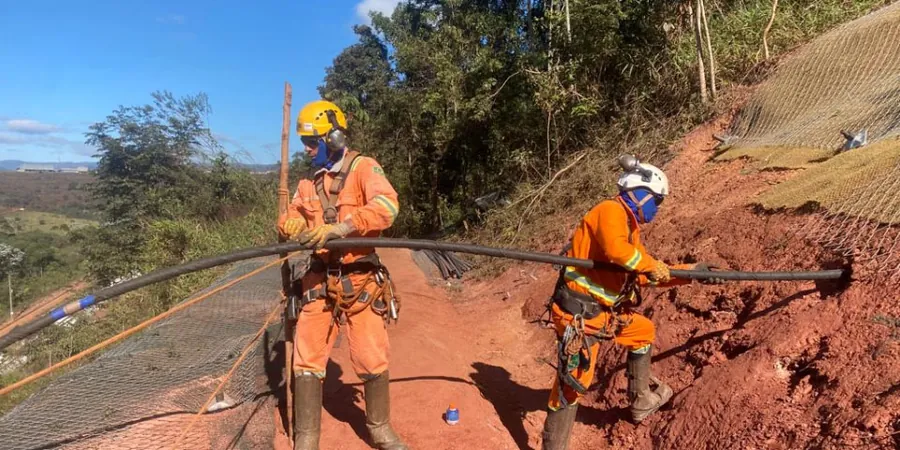
Creep rates of 0.2 mm per day in calcareous siltstone are invisible without continuous inclinometer data, yet they precede catastrophic failure by weeks.
Scope of work in Henderson Nevada
- In-place inclinometers with 0.01 mm resolution
- Tiltmeter arrays at bench crests
- Automated data loggers transmitting via cellular modem
Critical ground factors in Henderson Nevada
The contrast between the alluvial fans of Green Valley and the steep rock cuts along the 215 Beltway illustrates why a uniform monitoring approach fails. In the valley, granular soils drain quickly but can erode internally, while the mudstone slopes near Lake Mead Drive are prone to slaking after rain events. Without monthly data, a slope that appears stable after a dry spell may have lost 30% of its shear strength due to desiccation cracking in the claystone. Our service tracks pore pressure changes in piezometers and correlates them with rainfall intensity from the nearest NOAA station. This layered monitoring reduces the risk of unplanned road closures or foundation damage to adjacent structures.
Our services
Our monthly geotechnical slope monitoring in Henderson Nevada includes two integrated service tiers that address the specific failure modes of local geology.
Inclinometer and Tiltmeter Array
Permanent in-place inclinometers installed in borings of 76 mm diameter, coupled with surface tiltmeters at 10 m intervals along the slope crest. Data is logged hourly and transmitted daily for analysis. We provide a monthly report with cumulative displacement plots and trend lines.
Automated Alert System with Piezometer Integration
Vibrating wire piezometers monitor pore pressure changes within the slope mass, while automated data loggers send SMS alerts when displacement exceeds 0.5 mm in 24 hours. This is critical for slopes adjacent to active construction sites in Henderson Nevada where blasting or excavation can accelerate movement.
Frequently asked questions
What is the minimum duration for a monthly geotechnical slope monitoring program in Henderson Nevada?
We recommend a minimum of 12 months to capture seasonal moisture cycles and any seismic response. For active construction slopes, the program should run from pre-construction baseline through final grading and at least one rainy season.
How does the monitoring differentiate between normal thermal expansion and actual slope movement?
We install temperature sensors within the inclinometer casing and apply a linear correction factor derived from ASTM D6230-19 standard. Surface prisms are read at the same time of day to minimize thermal bias. Any signal exceeding the corrected baseline by 0.5 mm triggers a field inspection.
What is the cost of a monthly geotechnical slope monitoring program in Henderson Nevada?
The typical monthly cost ranges between US$420 and US$1.140 depending on the number of monitoring points, depth of inclinometer casings, and whether automated data transmission is included. A standard 5-point array on a 20 m slope falls near the middle of that range.
Can the monitoring system be integrated with existing site instrumentation?
Yes. Our data hub accepts Modbus, SDI-12, and analog inputs from third-party piezometers, strain gauges, and weather stations. We can merge these streams into a single monthly report, which is especially useful for large developments in Henderson Nevada where multiple contractors are working simultaneously.