A common mistake we see in Henderson Nevada is designing foundations or pavement sections based solely on laboratory compaction curves and SPT blow counts, without verifying the actual load-deformation behavior of the soil mass. The alluvial fan deposits in the eastern Las Vegas Valley often contain cemented layers mixed with loose sands, and a standard Proctor test does not capture the in-situ stiffness under a loaded plate. We use the plate load test (PLT) to measure the bearing capacity and modulus of subgrade reaction directly at the depth of interest, following ASTM D1194 (plate 300–750 mm) or ASTM D1195 for cyclic loading. The test provides a load-settlement curve that validates whether the design assumptions for spread footings, slab-on-grade, or pavement layers are realistic. For deep foundations we always cross-reference results with a capacity of load analysis to confirm the transition zone between shallow and deep behavior. In Henderson Nevada the presence of caliche layers can produce false high SPT values, and the PLT reveals whether that strength is continuous or just a thin crust.
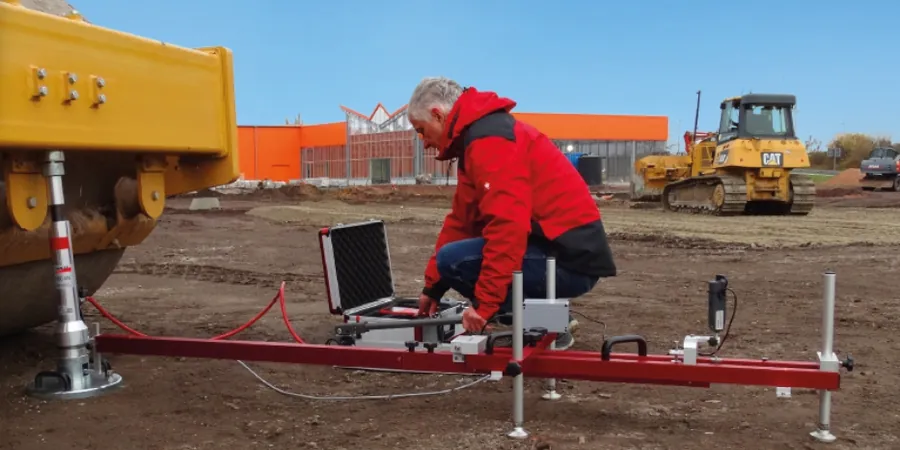
The PLT is the only in-situ test that directly measures the load-settlement relationship at the design bearing elevation, validating both modulus and ultimate capacity.
Scope of work in Henderson Nevada
- seating load cycles to bed the plate into any loose surface particles,
- incremental loading at 0.05 MPa steps with 5-minute holding periods,
- unloading and reloading to measure the rebound modulus,
- recording settlement with dial gauges fixed to independent reference beams.
Critical ground factors in Henderson Nevada
Our test setup in Henderson Nevada uses a 50-ton dump truck loaded with granular base material as the reaction mass. The truck must be positioned so its center of gravity is directly over the test plate, and the hydraulic jack applies load through a spherical seat to avoid eccentricity. The risk of punching failure in loose fill layers is real; we monitor the settlement rate continuously and stop the test if settlement exceeds 25 mm under a single load increment. A sudden plunging failure indicates that the soil below the plate is collapsing, often due to poorly compacted fill or a buried utility trench. When this occurs we recommend a geophysical survey with resistivity to map the lateral extent of the weak zone before proceeding with remedial compaction. In Henderson Nevada the water table is deep, typically 150 m below grade, so pore pressure is rarely a concern, but the dry conditions mean the soil can dilate rapidly and produce misleading stiff behavior on the first loading cycle.
Our services
We offer two complementary plate load test services adapted to the geotechnical conditions of Henderson Nevada.
Standard Static PLT (ASTM D1194)
Single-cycle incremental loading on a 600 mm steel plate with a hydraulic jack and reaction truck. Includes seating load, load-settlement curve, calculation of bearing capacity at 0.5 in. settlement, and k-value. Suitable for shallow foundation verification and pavement subgrade evaluation.
Cyclic PLT for Pavement Design (ASTM D1195)
Repetitive loading at 0.5 Hz to simulate traffic cycles, measuring permanent and resilient deformation. We apply 100 cycles at each load level and report the resilient modulus (Mr). Essential for flexible pavement design on the alluvial soils of Henderson Nevada.
Frequently asked questions
What is the difference between a plate load test and a CBR test?
The CBR test is a laboratory penetration test on compacted soil at a fixed moisture content, measuring the force required to push a 50 mm piston into the sample. The PLT is an in-situ test that loads a 300–750 mm plate on the actual soil mass at field moisture and density. The PLT captures the behavior of the full soil profile below the plate, including layering and stiff inclusions, while CBR only tests the top 100 mm of a remolded specimen.
How much does a plate load test cost in Henderson Nevada?
The typical cost for a single static PLT with a 600 mm plate, including mobilization, testing, and a standard report, ranges between US$960 and US$1.180. Cyclic tests with 100 cycles per load level add approximately US$300 to US$400 due to longer test duration and data processing. Volume discounts apply for projects with five or more test locations.
Can a PLT be performed on a slope or an existing foundation?
Yes, but the reaction system must be adapted. For slopes we use a reaction frame anchored with tie-down rods or concrete blocks placed on the uphill side. For existing foundations we can test directly on the footing surface by drilling through the floor slab and jacking against the overhead structure. The interpretation must account for the confinement effect of the existing foundation.
What k-value should I expect for compacted fill in Henderson Nevada?
Well-compacted granular fill (95% Standard Proctor or higher) typically yields k-values between 55 and 80 MPa/m on a 600 mm plate. Silty sands common in the western valley may give 35 to 50 MPa/m. If the fill contains more than 15% fines, we recommend verifying with a cyclic PLT to evaluate the resilient modulus for pavement design, as the long-term performance under traffic loading differs from static loading.