Henderson Nevada sits on a mix of alluvial fans, playa deposits, and buried paleochannels left by ancient Lake Lahontan. That geology matters when ground shaking hits. The soils here range from stiff gravelly sands near the McCullough Range to soft silt and clay layers in the Las Vegas Valley floor. For a seismic amplification analysis in Henderson Nevada, we measure shear-wave velocity profiles, resonant frequencies, and soil stiffness at depth. These data feed into site-specific response spectra that update the default ASCE 7 values. Many lots near Lake Las Vegas or Green Valley have variable fill and natural soil interfaces. Before we run the wave propagation models, we often pair the work with a georradar-gpr to map shallow anomalies. The goal is simple: know exactly how the ground will behave during an earthquake before you design the foundation.
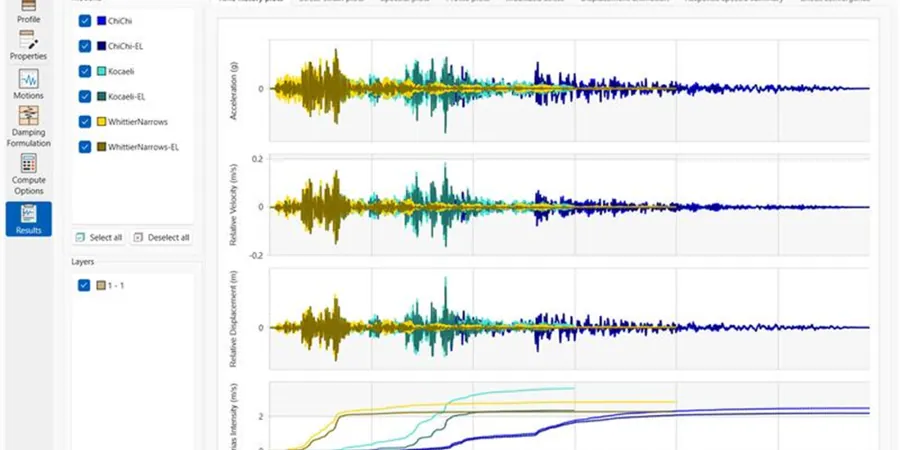
A site class C site in Henderson can amplify peak ground acceleration by 1.6 times compared to bedrock, changing design forces significantly.
Scope of work in Henderson Nevada
Demonstration video
Critical ground factors in Henderson Nevada
Summers in Henderson Nevada push soil temperatures above 120 F, which can dry out shallow clays and change their shear strength. That altered stiffness affects the seismic amplification analysis because dry soil transmits shear waves faster than moist soil. The water table here sits between 150 and 300 feet deep in most areas, so liquefaction risk is low — but the basin edge effects near the River Mountains can trap and focus surface waves. We see period elongation in soft alluvium zones around the Pittman Wash. If the analysis misses the basin-edge focusing, the design spectrum underestimates the actual demand on mid-rise structures. That risk is real for buildings taller than four stories.
Our services
We provide three complementary services to cover the full scope of seismic amplification work in Henderson Nevada.
MASW and VS30 Profiling
Active multichannel analysis of surface waves with 24-geophone arrays. Yields shear-wave velocity profiles to 30 m depth. Used to assign site class per IBC and compute amplification factors.
HVSR and Ambient Noise Recording
Three-component seismometer deployment for 72-hour continuous recording. Extracts the fundamental resonance frequency and peak amplitude of the soil column. Essential for period-sensitive structures.
Site-Specific Response Spectra
One-dimensional wave propagation analysis using DEEPSOIL or equivalent linear methods. Produces acceleration response spectra at the ground surface for MCE and DBE levels.
Frequently asked questions
What is the difference between VS30 and the fundamental site period?
VS30 is the average shear-wave velocity in the top 30 meters of soil. The fundamental site period depends on the total thickness and stiffness of the soil column above bedrock. A deep soft basin in Henderson Nevada can have a long period even if VS30 is relatively high.
How much does a seismic amplification analysis cost in Henderson Nevada?
A typical analysis ranges between US$1,120 and US$2,310 depending on the number of test locations, the depth of profiling, and whether you need full site-specific response spectra or just site class assignment.
What site classes are most common in Henderson Nevada?
Site class C (very dense soil and soft rock) dominates the eastern foothills. Site class D (stiff to medium-stiff soil) is common in the central valley near the 215 beltway. Site class B (rock) appears in the McCullough Range and Black Mountain areas.
Can I use the USGS web tool instead of a site-specific analysis?
USGS provides a generic site class map, but it often overestimates or underestimates amplification on local alluvium. In Henderson Nevada the USGS default may assign site class D when actual VS30 data show site class C, or vice versa. A site-specific analysis avoids that error.
How long does the field work and reporting take?
Field work for one location takes one day with two technicians. Data processing and inversion take three to five business days. The full report includes raw dispersion curves, inverted VS30 profiles, HVSR spectra, and the recommended response spectrum.