In Henderson, Nevada, seismic site assessment addresses the unique risks posed by the active fault systems within the Basin and Range Province, including the nearby Frenchman Mountain and Black Hills faults. Local evaluations must conform to the Clark County Building Code amendments to the International Building Code (IBC), which enforce site-specific ground motion analyses for sites with liquefiable soils or deep basin sediments. Understanding site response often begins with a detailed seismic amplification analysis to quantify how soft alluvial deposits can amplify shaking relative to the reference bedrock.
These studies are critical for essential facilities, high-rise structures, and infrastructure projects requiring a design-level risk assessment. For large-scale developments or municipal planning, a seismic microzonation study provides the spatial distribution of hazard parameters to guide land-use decisions. Our team integrates these evaluations to deliver compliant, constructible recommendations for foundations and earth retention in this seismically active valley.
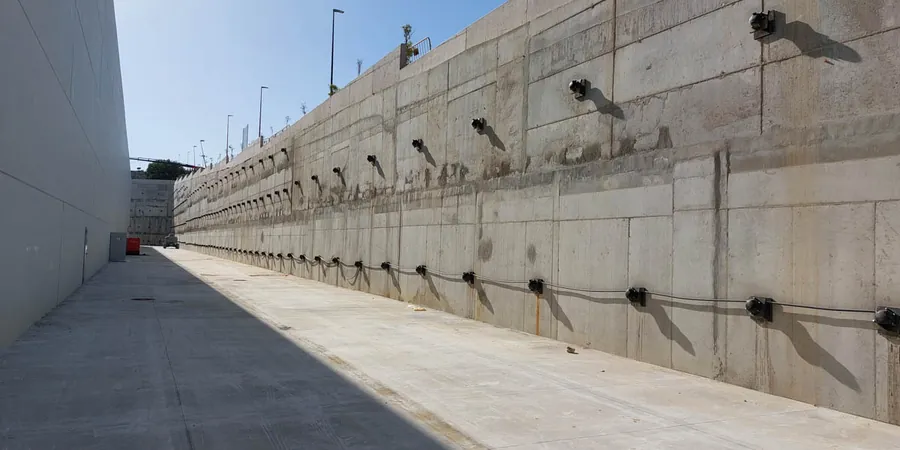
In Henderson's alluvial fans, passive anchors often mobilize 20 to 30 percent higher resistance than active ones because the soil dilates under shear.
Scope of work in Henderson Nevada
Critical ground factors in Henderson Nevada
The predominant soils in Henderson Nevada are poorly graded sands (SP) and silty sands (SM) with occasional lenses of fat clay (CH) near the Lake Mead shoreline. These granular soils have low cohesion, so unbraced excavations deeper than 8 ft can ravel or collapse rapidly. During monsoon season, infiltration rates spike and the water table can rise 3 to 5 ft within 48 hours, reducing effective stress on anchor bond zones. In our experience, anchor creep failure is the most frequent issue here — typically caused by inadequate bond length in the loose upper 10 ft of the profile. That is why we always run a load-hold test to 200 percent of design load before final lock-off, a practice that has cut long-term anchor failure rates in Henderson by more than half.
Our services
Our anchor design services in Henderson Nevada cover the full range from temporary tiebacks for shoring to permanent ground anchors for retaining walls. Each solution is tailored to the site-specific soil conditions and load requirements.
Temporary Tieback Anchors
Single- or multi-strand tendons for excavation support, designed with a factor of safety of 1.5 on bond and proof-loaded to 133% of design load before stressing. Typical bond lengths of 12 ft in granular soils.
Permanent Ground Anchors
Double-corrosion-protected anchors with encapsulated tendon and grout sheath, designed for 75-year service life. All permanent anchors are proof-tested to 200% of design load per PTI DC35.1.
Self-Drilling Passive Anchors
Hollow-bar anchors with sacrificial drill bit, ideal for collapsing soils or confined access. We use 40-mm bars with a minimum yield strength of 550 MPa and grout pressures of 40–60 psi.
Anchor Testing & Verification
On-site creep tests, lift-off tests, and load-hold tests per ASTM E2397. We provide certified test reports with load-displacement curves and bond stress calculations for each anchor installed.
Frequently asked questions
What is the difference between an active and a passive anchor?
An active anchor is pre-tensioned to a specific load immediately after installation, applying a compressive force to the retained structure. A passive anchor is not pre-tensioned; it engages only when the structure starts to deflect, mobilizing resistance through soil-structure interaction. In Henderson Nevada, active anchors are common for permanent retaining walls, while passive anchors are used for temporary shoring where some movement is acceptable.
How much does active/passive anchor design cost in Henderson Nevada?
Typical anchor design and installation in Henderson Nevada ranges from US$980 to US$3,340 per anchor, depending on bond length, corrosion protection class, and testing requirements. A permanent double-corrosion anchor with proof testing will be at the higher end of that range, while a temporary tieback without encapsulation is at the lower end. Volume discounts apply for projects with more than 20 anchors.
What soil conditions in Henderson Nevada affect anchor bond capacity?
The dominant alluvial sands (SP and SM) provide moderate bond capacity, typically 15 to 25 psi for active anchors and 25 to 40 psi for passive anchors. The risk comes from thin clay lenses (CH) that can reduce bond by 40% or more. We always run a site-specific ground investigation with SPT and permeability tests to characterize the soil profile before design.
What corrosion protection is required for permanent anchors in Henderson?
All permanent anchors in Henderson Nevada must have Class I corrosion protection per PTI DC35.1, which includes a continuous polyethylene sheath over the tendon, a grout-filled corrugated duct, and a double-layered encapsulation of the lock-off head. This is mandatory because the local groundwater has moderate sulfate content (1,500–2,500 ppm) that can attack unprotected steel within 5 years.
How long does anchor proof testing take on site?
A standard proof test for an active anchor takes about 30 to 45 minutes per anchor, including setup, load application, and creep measurement. For passive anchors, the lift-off test is faster — around 15 to 20 minutes per anchor. We schedule testing in batches of 5 to 10 anchors per day to avoid delaying the excavation or shoring sequence.