Henderson sits on a mix of alluvial fan deposits and lacustrine sediments from ancient Lake Lahontan. The groundwater table fluctuates between 6 and 15 meters depending on the district, which directly affects how soils behave under shear. We run the triaxial test in Henderson Nevada to determine cohesion and friction angle for foundation design, slope stability, and retaining wall projects. Before sampling, we coordinate with the calicatas exploratorias crew to ensure undisturbed block samples are taken at the correct depth. The unsaturated conditions common in the southeast part of town require special cell pressure calibration.
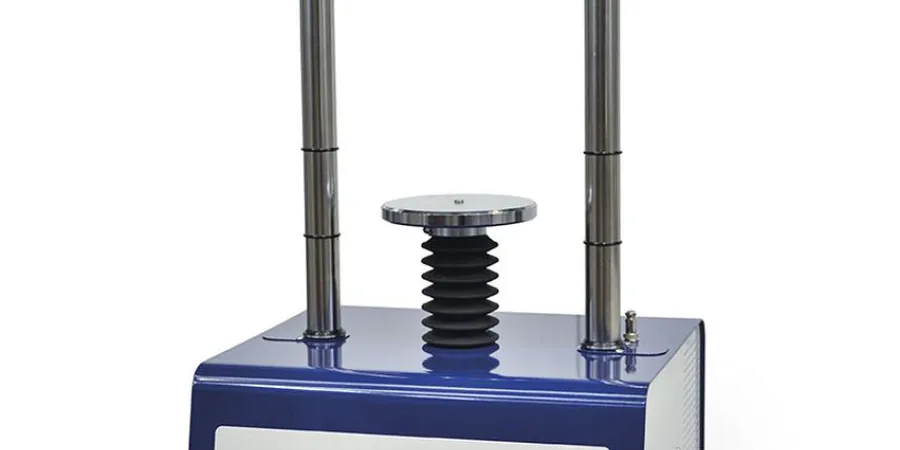
The triaxial test provides the Mohr-Coulomb envelope that every foundation engineer needs before signing off on a shallow footing design in Henderson.
Scope of work in Henderson Nevada
Critical ground factors in Henderson Nevada
Henderson grew fast in the 1990s and 2000s, pushing development onto piedmont slopes that were never tested for collapsible soil behavior. A triaxial test in Henderson Nevada run on a metastable sample can reveal a sudden drop in shear strength once the soil is wetted — exactly what happened on a subdivision project near Lake Las Vegas in 2008. The alluvial fans near Green Valley carry cobble lenses that make sample trimming difficult, and if the test is performed on disturbed material the friction angle may be overestimated by up to 6 degrees. That margin of error can turn a factor-of-safety of 1.5 into 1.3, which is why we always verify with ensayo SPT data in parallel.
Our services
We offer two standard triaxial configurations tailored to the soil conditions found in Henderson Nevada.
Consolidated-Undrained (CU) Triaxial
Measures effective stress parameters c' and φ' with pore pressure measurement during shearing. Ideal for rapid loading scenarios like earthquake analysis or fill placement in Henderson Nevada.
Consolidated-Drained (CD) Triaxial
Full drainage during shearing gives the long-term drained strength envelope. Applied to slope stability and retaining wall design where slow loading prevails.
Frequently asked questions
What does the triaxial test measure that a simple compression test cannot?
The triaxial test applies confining pressure to simulate actual burial depth, so you get the cohesion and friction angle under realistic stress conditions. Unconfined compression only gives you the unconfined compressive strength (qu) and ignores the confining effect that exists in the ground.
How much does a triaxial test cost in Henderson Nevada?
A standard CU triaxial test with three confining pressures ranges between US$2.050 and US$2.360, including sample preparation and a full Mohr-Coulomb report. CD tests run slightly higher due to longer consolidation and shearing stages. Volume discounts apply when testing multiple borehole samples from the same project.
When should I request CD instead of CU for a Henderson project?
Request CD when your design involves slow, drained loading — for example, a mechanically stabilized earth (MSE) wall or a long-term slope stability analysis. CU is appropriate for rapid construction, seismic loading, or short-term undrained conditions after excavation.